
Today’s B2B buyers don’t wait for sales outreach. They research independently, compare options across channels, and form strong opinions before they ever request a demo. By the time your team enters the conversation, buyers expect clarity, credibility, and proof.
That shift has made B2B video marketing a core growth driver.
Video builds trust faster than text alone. It simplifies complex solutions and helps prospects quickly understand who you are, what you do, and why you’re different. In competitive markets like healthcare, technology, industrial, and business services, that clarity can determine whether you make the shortlist.
Yet most companies treat B2B video as a creative project rather than a strategic lever.
They produce a brand video or a product overview and move on. The content looks polished, but it isn’t tied to demand generation, campaign strategy, or pipeline goals. Performance gets measured in views, not revenue impact.
That’s where the gap emerges.
The advantage doesn’t come from higher production quality. It comes from alignment. When video supports positioning, maps to the full buyer journey, integrates across channels, and connects to measurable outcomes, it becomes more than content. It becomes a system for growth.
So the real question isn’t whether you should use video. It’s whether you’ve built a B2B video marketing strategy that drives pipeline.
What Is a B2B Video Marketing Strategy?
A B2B video marketing strategy is a structured, full-funnel plan for using video to generate demand, influence pipeline, and drive measurable revenue growth.
It goes far beyond producing a few standalone assets. A true B2B video marketing strategy connects content to growth objectives and integrates video into the broader marketing engine.
At its core, a strong strategy includes:
- Clear marketing and pipeline objectives
- Alignment with your ideal customer profile and buyer personas
- Full-funnel coverage across awareness, consideration, and decision stages
- Defined messaging and positioning
- Cross-channel integration
- A measurement framework tied to business outcomes
Video marketing strategy goes beyond a single campaign or a one-time video series to build a repeatable demand-generation engine.
When video aligns with your ICP, reinforces your differentiation, and supports each stage of the buyer journey, it becomes a scalable asset. It supports lead generation, strengthens nurturing, accelerates sales conversations, and increases conversion rates.
Without that structure, even well-produced B2B video content struggles to drive measurable impact.
The 6-Step Framework for B2B Video Marketing Strategy
Once you understand what a B2B video marketing strategy includes, the next step is putting the structure into action. Strategy only drives results when it connects to real business priorities and operates inside your broader marketing engine.
That requires discipline. It means aligning video with revenue goals, mapping it to the buyer journey, integrating it into campaigns, and measuring performance beyond surface-level engagement. When those elements work together, video stops being a creative output and becomes a growth driver.
1. Align With Marketing & Pipeline Goals
Start with outcomes, not assets.
Before scripting a single B2B video, define what success actually means for your organization. Too often, teams begin with content ideas instead of commercial objectives. That’s where misalignment begins.
Clarify:
- Lead and MQL targets
- Pipeline contribution goals
- Sales enablement needs
- Revenue influence expectations
Then connect video performance directly to measurable business metrics:
- Demo bookings
- Opportunity creation
- Conversion rates
- Sales cycle velocity
This is where many B2B video marketing efforts break down. Marketing tracks views and engagement, while sales focuses on pipeline and revenue. If those conversations never intersect, video remains a marketing expense instead of a revenue lever.
When marketing and sales align around shared targets, video becomes part of the growth strategy. It supports lead generation, strengthens nurturing, and accelerates deal progression.
With goals clearly defined, the next step is to determine where video fits in the buyer journey.
2. Map Video to the Full Funnel
High-performing B2B video marketing strategies support the entire buyer journey, not just awareness.
If your video efforts concentrate on the top of the funnel, you’ll generate attention without momentum. To drive the pipeline, you need coverage across all three stages.
Top of Funnel: Attract
At this stage, buyers are identifying problems and exploring solutions. Your goal is visibility and credibility. Focus on:
- Educational content
- Industry insights
- LinkedIn thought leadership
- SEO-driven YouTube videos
These assets introduce your brand, demonstrate expertise, and build trust early.
Middle of Funnel: Nurture
Now prospects are evaluating options. They’re asking deeper questions and comparing approaches. Video should clarify and differentiate using:
- Explainers
- Use-case walkthroughs
- Webinars
- Case study content
This is where you reduce uncertainty and position your solution as the logical next step.
Bottom of Funnel: Convert
At the decision stage, buyers want proof and precision. They need confidence that your solution will deliver results. Strong decision-stage video includes:
- Customer testimonials
- Deep-dive demos
- FAQ videos
- Sales outreach videos
In complex industries such as manufacturing, healthcare, and technology, video often plays a critical role in accelerating buyer understanding and trust. When buyers need to see how a product works, how a process unfolds, or how outcomes are delivered, visual clarity can shorten evaluation cycles and reduce perceived risk.
That’s why bottom-of-funnel video often has the most direct impact on sales velocity and pipeline progression.
3. Clarify Positioning Before Production
Video amplifies positioning. It doesn’t fix weak messaging.
Before production begins, define the strategic foundation behind your content:
- Your category narrative
- Clear differentiation
- Core customer pain points
- Messaging pillars
Every video should reinforce the same positioning that appears on your website, in your paid campaigns, and in sales conversations. Consistency builds authority. Fragmented messaging creates confusion.
If your positioning feels vague or interchangeable, video will magnify that weakness. On the other hand, when your narrative is sharp and differentiated, video becomes a powerful reinforcement tool.
4. Prioritize Distribution & Channels
Even the strongest B2B video content won’t perform without intentional distribution.
Start by identifying where your ICP spends time and which channels impact your pipeline. In many B2B industries, core channels include:
- LinkedIn, both organic and paid
- YouTube for search visibility and authority
- Website conversion pages
- Email nurture sequences
- Retargeting campaigns
Each channel serves a different purpose. A LinkedIn ad needs to stop the scroll. A YouTube video needs to answer search intent. A sales enablement video needs to address objections quickly and clearly.
Channel strategy should guide format, structure, and investment. When distribution is an afterthought, performance stalls. When distribution is intentional, video becomes a scalable acquisition tool.
5. Integrate Video Into Campaigns
Video shouldn’t sit in a content library waiting to be discovered. It should actively support marketing initiatives.
Instead of treating video as a standalone asset, embed it into:
- Demand generation campaigns
- LinkedIn ad programs
- Retargeting sequences
- ABM initiatives
- Email nurture workflows
- Sales outreach
When video supports campaigns, performance improves across the board. Click-through rates increase. Engagement deepens. Conversion rates climb.
Integration also strengthens alignment between marketing and sales. Sales teams can use video to reinforce value propositions, address objections, and personalize outreach.
When video operates inside your campaign structure, it becomes a force multiplier rather than a creative add-on.
At that point, measurement becomes critical.
6. Measure Marketing Impact, Not Just Views
Views are indicators. Pipeline impact is the outcome.
To measure B2B video marketing effectively, track performance by funnel stage to see how video influences progression through the funnel.
Awareness Metrics
- Engagement rate
- Watch time
- Audience growth
These metrics show whether your content is attracting and holding attention.
Consideration Metrics
- Click-through rate
- Landing page conversions
- Assisted conversions
These indicators reveal whether video is driving deeper engagement and influencing evaluation.
Decision Metrics
- Pipeline influenced
- Cost per opportunity
- Revenue attribution
- Sales velocity
When you can connect content to influenced pipeline and accelerated deals, you move beyond surface metrics.
This structured approach shifts the conversation from creative performance to commercial impact. And when video performance ties directly to revenue outcomes, it earns long-term investment and executive buy-in.
Video B2B Marketing Timeline & Expectations
Once your B2B video marketing strategy is in place, the next question is timing. When should you expect results?
Like any integrated marketing initiative, video performance builds over time. Some impact happens quickly. Stronger gains compound as distribution, optimization, and authority grow.
Here’s what that progression typically looks like.
0 to 60 Days: Production & Early Testing
In the first phase, focus on building the foundation.
You’ll finalize messaging, produce initial assets, and begin distributing across priority channels such as LinkedIn, YouTube, email, and retargeting. Early metrics will center on engagement, watch time, and click-through rates.
At this stage, you’re validating messaging, testing formats, and identifying which themes resonate most with your ICP. While you may see early demo bookings or assisted conversions, the primary goal is momentum and data.
This phase sets the baseline for long-term performance.
3 to 6 Months: Measurable Campaign Impact
With consistent distribution and campaign integration, results become more visible.
You may see:
- Improved paid campaign performance
- Higher demo conversion rates
- Increased retargeting efficiency
- Stronger mid-funnel engagement
Video begins influencing evaluation and decision-making. Prospects arrive better educated. Sales conversations move faster. Objections get addressed earlier in the process.
At this stage, video shifts from experimentation to a performance contributor.
6 to 12 Months: Compounding Growth
By the six- to twelve-month mark, the compounding effect becomes clear.
SEO-driven YouTube content gains authority and organic visibility. Retargeting audiences grow. Sales teams use video more consistently in outreach. Pipeline influenced by video becomes measurable and repeatable.
You may see:
- Stronger inbound pipeline
- Increased opportunity creation
- Improved sales velocity
- Clearer revenue attribution
During this stage, B2B video marketing transitions from a supporting tactic to a strategic asset.
Video is not a short-term spike. It’s a compounding marketing engine. When appropriately integrated, each asset continues working long after launch, strengthening brand authority and pipeline performance over time.
B2B Video Best Practices: What Separates High-Performing Programs
Not all B2B video marketing programs drive measurable growth. The difference rarely comes down to creativity or budget. It comes down to strategic alignment, integration, and accountability.
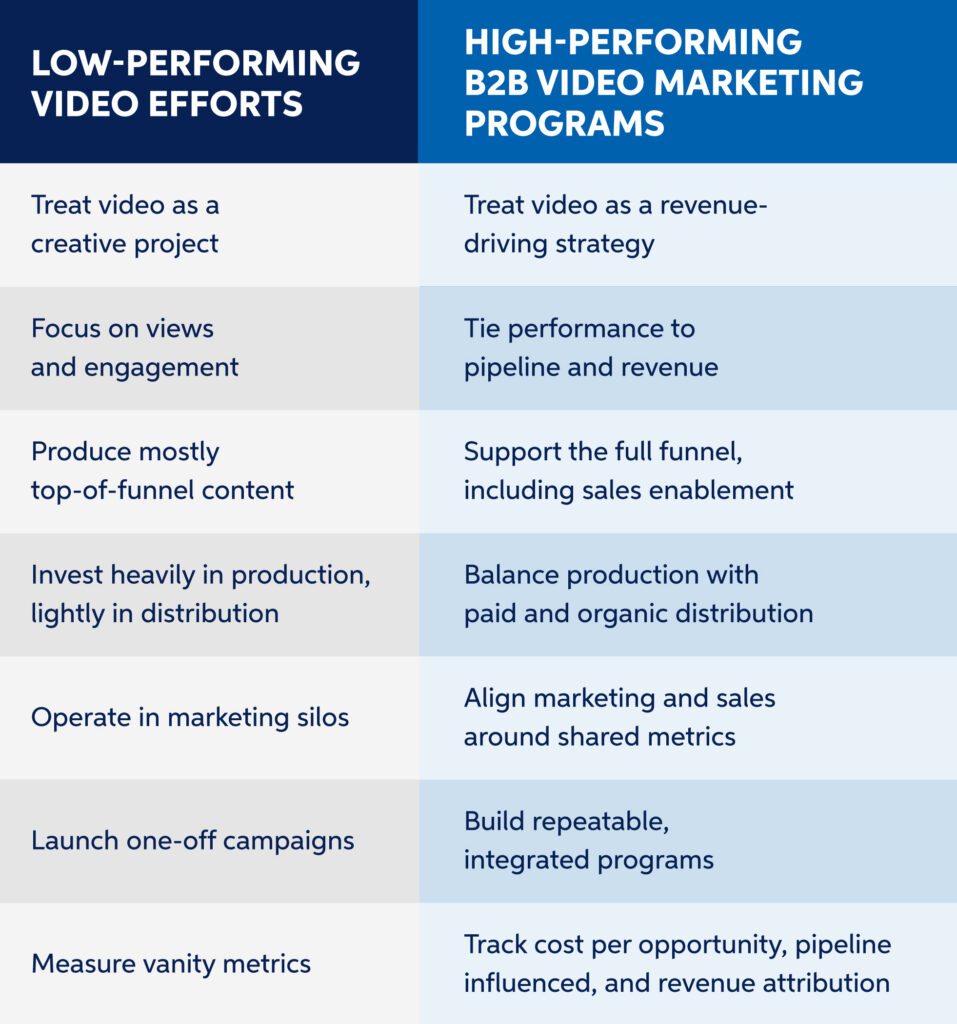
Low-performing programs often generate attention but fail to influence buying decisions. They create awareness without conversion. Over time, leadership questions the ROI because engagement doesn’t translate into pipeline.
High-performing programs take a different approach. They design B2B video marketing around commercial outcomes from the start. Every asset has a role within the buyer journey. Distribution is intentional. Sales teams actively use video in conversations. Measurement connects content to revenue impact.
The result is stronger conversion rates, improved sales velocity, and clearer attribution.
Common Questions About B2B Video Marketing
With the framework and best practices defined, the remaining questions are practical. How should you approach platform selection? What does ROI really look like? And how much investment does a strong B2B video marketing strategy require?
Here are clear answers to the most common executive questions.
What is a B2B video marketing strategy?
A B2B video marketing strategy is a structured plan for using video across channels to attract, nurture, and convert ideal customers. It connects video content to marketing objectives, pipeline goals, and revenue outcomes. Rather than producing isolated assets, companies build integrated programs that support every stage of the buyer journey. When aligned properly, B2B video marketing becomes a repeatable demand-generation engine.
How does video support demand generation?
Video supports demand generation by increasing engagement, accelerating trust, and improving conversion across the funnel. At the awareness stage, it builds visibility and authority. In the consideration and decision stages, it clarifies differentiation, addresses objections, and strengthens buyer confidence. When integrated into campaigns, video B2B marketing drives demo bookings, nurtures leads, and influences the pipeline.
Which platforms are best for B2B video marketing?
The best platforms for B2B video marketing are those that influence your ICP and pipeline. For many organizations, that includes LinkedIn for paid and organic reach, YouTube for SEO visibility, website conversion pages, email nurture programs, and retargeting campaigns. Platform selection should align with buyer behavior and revenue impact, not just engagement metrics. A strong B2B video marketing strategy integrates video across multiple channels rather than relying on a single channel.
How do you measure ROI from B2B video marketing?
You measure ROI from B2B video marketing by connecting performance to pipeline and revenue, not just views. Key metrics include pipeline influenced, cost per opportunity, revenue attribution, and sales velocity. Funnel-stage metrics such as click-through rate and landing page conversions help link engagement to opportunity creation. When you measure video against commercial outcomes, its value becomes clear and defensible.
Should B2B companies invest in YouTube?
Yes, B2B companies should invest in YouTube when it aligns with search intent and long-term visibility goals. YouTube strengthens SEO authority, captures early-stage research traffic, and supports educational content at scale. Over time, optimized video content compounds in search rankings and influences the inbound marketing pipeline. Within a broader B2B video marketing strategy, YouTube serves as a strategic acquisition channel.
How much should B2B companies budget for video marketing?
B2B companies should budget for both production and distribution when investing in video marketing. High-performing programs allocate resources to content creation, paid amplification, platform optimization, and performance tracking. Budget levels vary by scope and growth targets, but investment should align with pipeline expectations. When video ties directly to revenue goals, it shifts from a discretionary expense to a strategic growth investment.
Building a Scalable Video Engine
B2B video marketing only delivers meaningful impact when it’s built with intention and integrated into your broader growth strategy.
Production quality alone won’t drive the pipeline. What creates sustained results is alignment. When video connects to revenue goals, supports each stage of the buyer journey, reinforces clear positioning, and integrates across campaigns, it shifts from a creative asset to a strategic growth lever.
The mindset shift is subtle but significant. Instead of asking what video to produce next, high-performing teams ask what business objective they need to influence. That change shapes everything, from messaging and distribution to measurement and optimization.
When that discipline is applied consistently, results compound in a measurable way. Brand authority grows as your perspective surfaces repeatedly across channels. Conversion rates improve because prospects arrive better informed. Sales conversations move more efficiently because you’ve already addressed objections. Over time, the video-influenced pipeline becomes predictable rather than anecdotal.
That’s the difference between simply using video and building a true B2B video marketing strategy.
At Sagefrog, we help B2B organizations integrate video into a results-driven marketing system. From strategy and messaging through distribution and measurement, our team ensures video supports demand generation, sales enablement, and measurable ROI.
If you’re ready to elevate your B2B video marketing and accelerate pipeline growth, contact us to start the conversation.