Type your company’s name into ChatGPT, Claude, Gemini, or Perplexity and ask: “What are the primary pros, cons, and client complaints about working with [Your Brand] compared with our top three competitors?” What the AI returns is increasingly shaping what prospective buyers see during their anonymous research.
B2B buyers no longer rely solely on Google searches, analyst reports, or official brand collateral when evaluating potential vendors. They’re also using conversational AI tools as first-pass research assistants to compare companies, summarize capabilities, weigh potential risks, and narrow down their options before they ever reach out to sales.
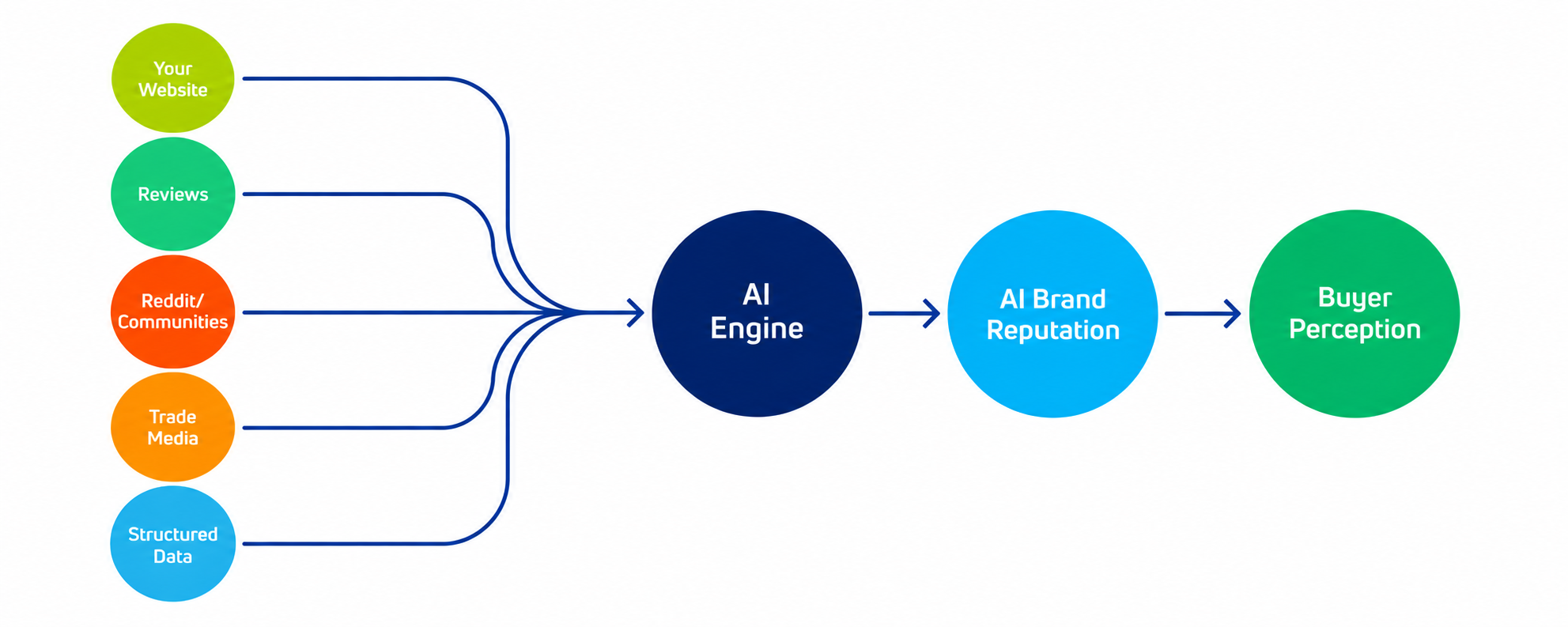
That means your prospects aren’t only seeing the story your website tells. They’re seeing a synthesized version of your brand built from information scattered across the web. Every B2B company now has an AI brand reputation—a machine-generated narrative shaped by your owned content, third-party reviews, industry coverage, community discussions, and other digital signals that can influence whether your company makes the shortlist.
Managing that perception requires marketers to move beyond traditional SEO and take a more proactive approach to Generative Engine Optimization (GEO), entity reputation management, and the broader digital consensus surrounding their brand.
How AI Brand Monitoring Shapes Your Market Perception
Traditional brand monitoring typically focuses on search rankings, social mentions, reviews, media coverage, and sentiment. AI brand monitoring adds another important layer: understanding how AI engines interpret all of those signals together when someone asks a question about your company.
AI-generated brand perception isn’t based solely on what you say about yourself. AI engines don’t necessarily take your website copy at face value; they may evaluate your claims against the broader digital consensus surrounding your brand. That can include peer communities, review platforms, trade publications, press releases, and other third-party sources. Rather than evaluating your brand through a single channel, these systems can synthesize multiple signals into one concise answer.
Peer Communities
Unfiltered peer communities can be especially influential because they contain candid discussions about software performance, service quality, implementation experiences, and vendor reliability. Reddit threads, specialized Slack communities, industry forums, and other digital communities often provide the kind of real-world commentary prospects look for when they want perspectives beyond polished marketing messaging.
Third-Party Review Platforms
Third-party review platforms such as G2, Capterra, and TrustRadius add another layer of external validation, while employee feedback platforms such as Glassdoor can contribute broader context about a company’s reputation.
Structured Third-Party Sources
Structured sources matter, too. Press releases, industry publications, company profiles, and authoritative third-party coverage can help reinforce facts about your offerings, leadership, partnerships, expertise, and market position. Together, these sources contribute to the digital consensus surrounding your brand and help shape the version of your company that AI engines present to buyers.
The risk is that if information about your company is inconsistent, outdated, sparse, or disproportionately negative, AI-generated summaries may not reflect the way you want to be understood. They may omit important differentiators, repeat old information, generate vague descriptions, or give too much weight to a handful of critical comments. If a prospect encounters that version of your brand before ever visiting your website, it can shape their perception of your company before you ever have a chance to tell your own story.
Step 1: Conduct an AI Brand Audit Across Core LLMs
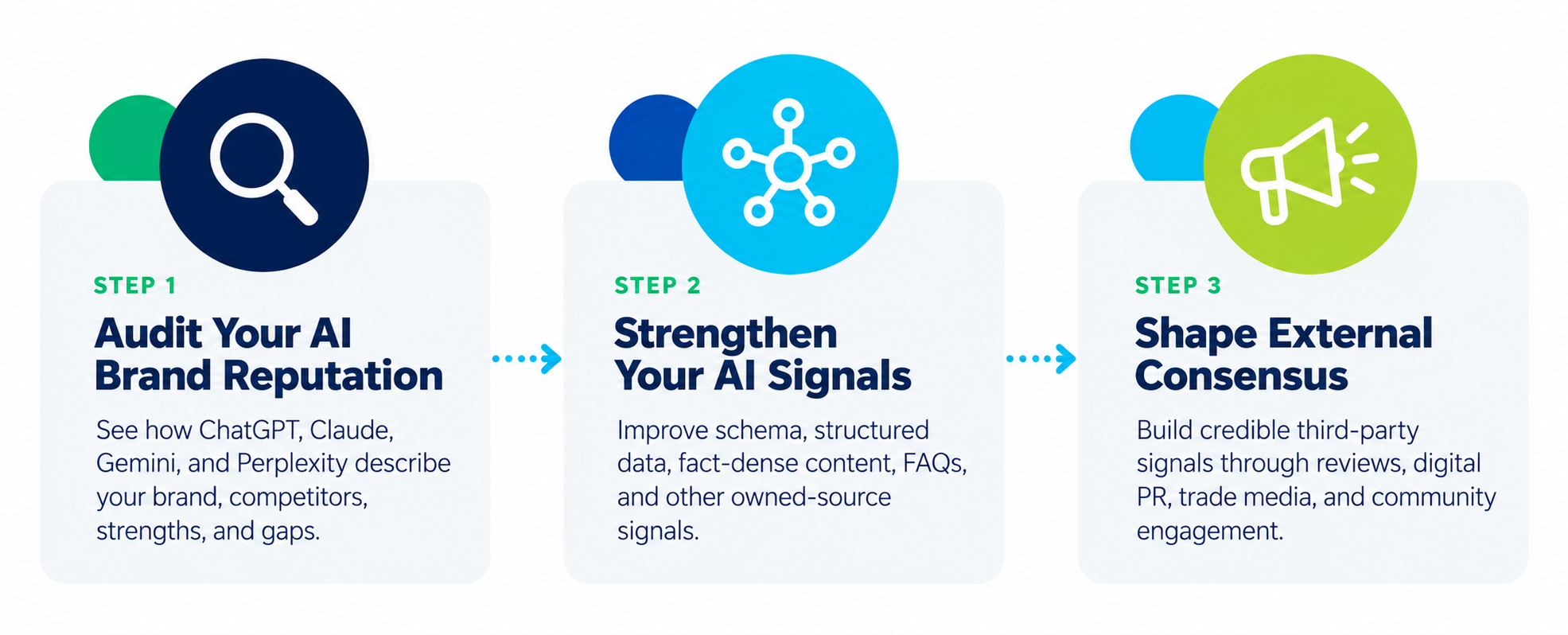
You can’t improve your AI brand reputation if you don’t know what it looks like today. An AI brand audit gives your marketing team a baseline by systematically testing how major generative AI platforms summarize your business, compare you with competitors, and respond to the kinds of questions real buyers might ask.
Start by creating a consistent set of buyer-style prompts and running them across ChatGPT, Claude, Gemini, and Perplexity. Rather than limiting yourself to “What does [Brand] do?” test questions that reflect different stages of the evaluation process.
Put Your AI Brand Reputation to the Test
Try these prompts in ChatGPT, Claude, Gemini, and Perplexity to see how your brand is being represented today.
- “What are the top five vendors for [category] in [industry]?”
- “What are the pros and cons of working with [Brand]?”
- “Is [Brand] reliable for enterprise deployments?”
- “How does [Brand] compare with [Competitor A] and [Competitor B]?”
- “What complaints do clients have about [Brand]?”
As you review the results, look for patterns in sentiment, accuracy, and missing information. Does the AI accurately describe your services? Are your strongest differentiators appearing consistently? Is it referencing an outdated pricing structure or positioning statement? Is it inventing limitations that don’t actually exist or attributing capabilities to your company that you don’t offer? Just as importantly, note where competitors appear more frequently or are consistently framed as category leaders.
Competitor comparison is especially useful because it can help uncover the external signals influencing AI perception. If the same companies appear repeatedly in recommendations, investigate the underlying sources that may be supporting that visibility. They may have stronger third-party coverage, richer review profiles, clearer product information, more consistent messaging, or more frequent mentions across authoritative sources. The goal of the audit is to turn a vague concern about “how AI sees us” into a measurable view of where your brand is strong, weak, or misunderstood.
Step 2: Use Generative Engine Optimization B2B Strategies to Feed AI Clearer Signals
Once you understand where your AI reputation is weak, the next step is making your company easier for machines—and people—to understand. That’s where generative engine optimization B2B strategies come into play.
Strong brand messaging still matters, but AI engines benefit most from information that is clear, structured, specific, and easy to verify. In practice, that means supplementing conversational marketing copy with factual content that clearly defines who your company is, what it offers, who it serves, and how its products or services relate to one another.
Structured schema markup can support that clarity by helping web crawlers interpret core information about your company and offerings. Depending on your business, that may include Organization, Product, Service, FAQ, or other relevant schema types. The point isn’t to add schema simply because “AI likes schema.” It’s to create a more consistent, machine-readable representation of your brand that reduces ambiguity about what your company actually does.
Your content should also move away from vague marketing claims when stronger evidence is available. Phrases like “best-in-class,” “innovative,” or “industry-leading” communicate very little without proof. Instead, look for opportunities to strengthen your content with fact-dense, evidence-backed information such as:
- Measurable client outcomes and case study results
- Specific products, services, and capabilities
- Certifications, partnerships, and technical expertise
- Industries served and relevant experience
- Implementation details, timelines, and support models
| Instead of… | Try… |
|---|---|
| “Our company has an industry-leading implementation process.” | “Our implementation framework helped a healthcare technology client reduce onboarding time by 32% over six months.” |
The first statement contains an outcome, context, and evidence. The second is a broad claim that’s difficult to validate.
FAQs can also play an important role by allowing you to answer buyer questions in a direct, structured format. Build them around the kinds of prompts prospects are likely to use in AI engines, including questions about integrations, pricing models, implementation, support, security, industry experience, common objections, and competitive differences. The objective isn’t to manipulate AI output. It’s to make accurate, useful information about your company easier to find, interpret, and summarize.
Step 3: Shape External Consensus Through B2B Brand Management
Your website is only one piece of your brand reputation, which is why effective B2B brand management increasingly requires attention to what happens beyond your owned channels. Because AI engines can draw heavily from third-party conversations, reviews, and media coverage, off-site digital PR, reviews, and community presence can be just as important as on-site SEO. Much of that influence happens within the B2B dark funnel, where prospects research your company before they ever identify themselves to sales.
That makes community engagement an important part of reputation management. Monitor relevant conversations on Reddit, industry forums, and professional communities where your market gathers. When it makes sense to participate, do so transparently and with the goal of being helpful. Correct factual inaccuracies, provide useful context, and contribute expertise without turning every interaction into a promotional opportunity.
Digital PR and trade media can strengthen your external presence as well. Thought leadership, expert commentary, original research, case studies, and contributed articles in respected industry publications can create independent signals about your expertise and market position. Consistent third-party coverage gives both buyers and AI systems more credible information to reference when they’re trying to understand what your company knows and where it fits in the market.
Reviews are another critical component. A strong review strategy gives satisfied clients a place to share their experiences on platforms buyers may already trust. Build a repeatable process for capturing client success stories and requesting feedback after successful engagements, then monitor reviews closely enough to respond thoughtfully when concerns arise. The goal isn’t to create a perfectly positive profile. A credible reputation is one that shows consistent evidence of strong client experiences, responsive communication, and follow-through.
The Goal: Give AI engines more accurate, credible signals to work with throughout the B2B buying journey.
Your AI Brand Reputation Is Becoming Part of the B2B Buying Journey
Your prospects may be learning about your company from an AI-generated answer before they ever see your homepage. That changes the job of brand management because marketers are no longer optimizing only for search rankings or controlling messaging on owned channels. They’re managing an interconnected ecosystem of facts, opinions, reviews, media coverage, community discussions, and structured data that can collectively influence how AI engines describe a business.
The companies that adapt and survive will treat AI brand reputation as an ongoing marketing discipline rather than a one-time optimization project. That means auditing how leading AI platforms perceive and summarize your company, strengthening structured entity data and fact-rich content, and shaping the third-party digital consensus surrounding your brand. Together, those efforts give AI assistants more accurate, credible information to work with as buyers evaluate their options.
When a high-intent buyer asks an AI assistant, “Which company should I consider?” the goal is to ensure your digital presence gives that AI plenty of accurate, credible reasons to include your brand in the answer.
Build a Stronger AI Brand Reputation with Sagefrog
Sagefrog helps B2B companies connect brand strategy, SEO, content, digital PR, and emerging GEO practices into integrated marketing programs built around how buyers actually research today.
Contact our team to strengthen how your brand appears across search, AI platforms, third-party sources, and the broader digital buying journey.
Frequently Asked Questions (FAQs)
What is the difference between traditional SEO reputation and AI brand reputation?
Traditional SEO reputation focuses on how your company appears in search results, including indexed pages, metadata, rankings, backlinks, reviews, and business profiles. AI brand reputation is broader because it reflects the synthesized narrative an AI platform generates after pulling together information from multiple sources.
Instead of simply presenting a list of links, a Large Language Model (LLM) may summarize your brand’s capabilities, strengths, weaknesses, and competitive position using information from your website, forum discussions, third-party reviews, trade media, and other digital sources. That means marketers need to think not only about whether their brand ranks, but also about whether the broader information surrounding it is accurate, consistent, and credible.
How can a B2B company address incorrect information or hallucinations generated by AI tools?
Because you generally can’t directly edit an AI platform’s answer, correcting inaccurate information starts with strengthening the underlying digital sources that describe your company. Make your website copy clear and unambiguous, implement relevant structured entity data, and keep important third-party profiles current.
That may include updating platforms such as G2, Crunchbase, or Wikipedia/Wikidata where appropriate, publishing verified facts through press releases and authoritative content, and addressing inaccurate claims in public communities such as Reddit. Over time, stronger and more consistent source information can improve the context AI systems have available when generating summaries about your brand.
Why do Reddit and third-party review sites matter for B2B AI reputation?
Peer discussions and third-party reviews can provide something a company’s own marketing materials cannot: independent validation and firsthand perspectives. Platforms such as Reddit, G2, Glassdoor, and industry forums may contain real-world commentary about implementation, service, performance, reliability, and support.
Because those sources contribute to the broader digital context surrounding a company, they can influence how AI systems interpret and summarize a brand. If the same concerns or strengths appear repeatedly across independent sources, they can become an important part of the overall narrative buyers encounter.
How often should B2B marketers conduct an AI brand audit?
A quarterly AI brand audit is a practical starting point for most B2B companies. It’s also worth conducting an additional audit after major changes such as a product launch, rebrand, pricing update, acquisition, or significant shift in positioning.
Using the same standardized buyer prompts across ChatGPT, Claude, Gemini, and Perplexity makes it easier to compare results over time and identify changes in how different AI platforms represent your brand. That gives your marketing team a clearer view of where your AI brand reputation is improving and where new content or reputation gaps may be emerging.