The traditional B2B marketing playbook is changing. While company pages and executive content still play an important role, buyers are increasingly engaging with individuals over brands. On platforms like LinkedIn, authentic perspectives from real professionals often outperform polished corporate messaging because people trust people.
Yet many B2B companies continue to limit their expertise to a handful of executives or brand channels. In doing so, they overlook one of their most valuable assets: the subject-matter experts throughout their teams. From strategists and account managers to creatives and digital specialists, employees are having conversations with clients every day that can fuel meaningful industry insights.
That’s where employee thought leadership comes in. By empowering team members to share their expertise, companies can build trust, expand reach, and create stronger connections with prospects through B2B thought leadership.
Modern B2B brand strategy doesn’t just include logos, messaging, and visual identity; it’s about creating an integrated ecosystem of trusted voices that collectively strengthen your market presence. That includes an Influencer Brand Strategy that empowers your greatest assets—your team—to share expertise, build credibility, and amplify your brand in ways corporate channels alone cannot.
What is Employee Thought Leadership (& Why Does It Matter Now?)
Employee thought leadership is the practice of empowering team members across your company to share their expertise, insights, and perspectives publicly. At its core, it’s the decentralization of expertise, moving beyond the CEO or executive team as the sole voice of the brand and activating subject matter experts across strategy, creative, account management, digital marketing, and other disciplines.
The timing couldn’t be better.
LinkedIn’s algorithm increasingly rewards original, first-person content over generic corporate updates. Buyers are more likely to engage with professionals sharing real experiences than with polished brand messaging. In fact, according to a recent survey by The Harris Poll, 78% of people say that posts from employees feel significantly more authentic than official corporate marketing materials.[i] As a result, employee-generated content often drives stronger engagement, greater visibility, and more meaningful conversations.
It also aligns with a fundamental marketing principle: know your audience. Employees on the front lines hear client questions, challenges, and concerns every day. They are uniquely positioned to create content that addresses the issues prospects are actively trying to solve. By turning those everyday interactions into insights, companies can create more relevant content while demonstrating a deeper understanding of their audience’s needs.
Thought Leadership Business Impact: The Core Benefits of Activating Employee Voices
When employees become active thought leaders, the benefits extend well beyond social media engagement. From building trust to expanding reach and attracting talent, employee advocacy can have a measurable impact on business growth.
Humanize Your Brand & Build Trust
B2B buyers want confidence in the people behind the services they purchase. When employees share their expertise publicly, they provide a more authentic view of your company’s capabilities, culture, and depth of knowledge. Seeing diverse perspectives from the people doing the work every day helps validate your expertise and build trust in your ability to deliver results.
Multiply Organic Reach
Even the strongest company pages face limitations in organic visibility.
When five, 10, or even 20 employees share content with their own professional networks, the cumulative reach can far exceed what a corporate account can achieve on its own. Each employee introduces your brand to new audiences, industries, and conversations, significantly expanding your organic footprint.
Drive Demand & Inbound Opportunities
Consistently sharing value-first content positions employees as trusted experts. Over time, prospects begin viewing your team as the go-to resource for industry insights and solutions.
This creates a natural pathway from awareness to inquiry, helping generate warmer inbound opportunities and reducing reliance on cold outbound tactics.
Strengthen Employer Branding
Thought leadership isn’t only attractive to prospects; it’s attractive to talent.
Companies that encourage employees to develop their personal brands demonstrate a culture of trust, professional growth, and innovation. This not only helps attract top talent but also positions your company as a place where future industry leaders can thrive.
B2B Thought Leadership Strategy: Building a Successful Employee Rotation Program
Most companies recognize the value of thought leadership. The challenge is maintaining consistency.
Employees are busy. Client work takes priority. Even enthusiastic contributors can struggle to find the time or inspiration to post regularly. Everyone wants to participate in thought leadership, but competing priorities and writer’s block often get in the way.
That’s why structure matters.
At Sagefrog, we’ve found success through an internal rotation process that distributes ownership across the team. Rather than relying on the same voices repeatedly, employees take turns sharing insights tied to their expertise and experiences. This approach helps ensure a steady flow of content while giving team members the opportunity to build their personal brands and contribute to the agency’s visibility.
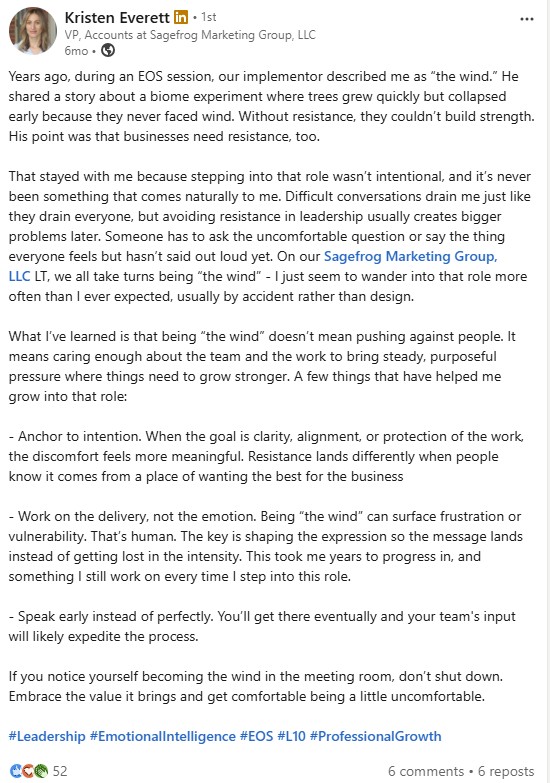
At Sagefrog, we practice what we preach: A snapshot of our internal rotation program, driving real engagement on LinkedIn.
We also look for opportunities to align thought leadership topics with broader company initiatives and content themes. By connecting employee posts to strategic focus areas, individual perspectives can reinforce larger marketing objectives while adding a more personal, relatable point of view.
For companies looking to launch an impactful B2B thought leadership plan, there are a few best practices to follow.
Establish Content Pillars Based on Expertise
Give employees clear topics aligned with their roles and strengths.
For example:
- Strategists can discuss positioning, planning, and industry trends.
- Digital specialists can share insights on analytics, advertising, and emerging technologies.
- Creative team members can explore branding, design, and user experience.
- Account managers can address client communication and relationship-building, and common client challenges.
Encourage employees to draw from their day-to-day experiences. While company content often focuses on broader trends and business priorities, employee thought leadership can bring those topics to life through real-world examples, lessons learned, and client-facing insights.
Reduce Friction with Templates & Prompts
One of the biggest barriers to participation is uncertainty about where to begin.
Providing templates, prompts, and simple submission processes can make content creation feel far more approachable. Light editorial support can also help employees feel confident before publishing, making it easier to maintain momentum over time.
And when someone is struggling to identify a topic or develop a post, don’t be afraid to workshop ideas together. A collaborative approach can help employees uncover valuable insights they may not realize are worth sharing.
Encourage Internal Engagement
Employee thought leadership works best when it’s supported by the broader team.
Encouraging colleagues to engage with posts through comments, reactions, and shares can help build momentum when content goes live while reinforcing a culture of collaboration and knowledge sharing.
Consistency matters here, too. At Sagefrog, thought leadership is incorporated into our broader content cadence, helping create a balanced mix of employee perspectives and company-generated content throughout the year.
B2B Thought Leadership Best Practices: How Brands Can Get Started
Launching an employee thought leadership initiative doesn’t require a complex program. Start with a few strategic fundamentals.
Align With Brand Messaging Without Sounding Scripted
Employees should understand your company’s focus areas and priorities, but they shouldn’t sound like corporate spokespeople.
Provide guardrails, not scripts. Authenticity is what makes thought leadership effective. The goal is to ensure content aligns with your brand’s expertise and industry standards while still allowing employees to communicate in their own voice.
Turn Everyday Conversations into Content
The best thought leadership comes from daily interactions.
Client questions, project challenges, industry discussions, and internal problem-solving sessions can all become valuable sources of thought leadership. Encourage employees to turn real-world questions, client wins, and solved roadblocks into educational content that provides genuine value to their audience.
Integrate Thought Leadership into Your Marketing Strategy
Employee thought leadership should complement—not compete with—your broader marketing efforts.
When employees consistently share insights related to strategy, creative execution, digital marketing, or industry trends, they reinforce the same value proposition your brand communicates through campaigns, content, and business development efforts.
At Sagefrog, we view employee thought leadership as a natural extension of B2B strategy and integrated marketing. Rather than existing in a silo, employee advocacy should work alongside your content marketing, branding, digital marketing, and business development initiatives to strengthen visibility, credibility, and market influence.
Turning your employees into thought leaders is a highly effective, modern B2B growth strategy.
By empowering employees to share their expertise, companies can bridge the gap between corporate messaging and human trust. The result is stronger brand credibility, broader reach, deeper audience engagement, and a more sustainable approach to growth. It’s time for companies to recognize that their greatest asset isn’t actually their brand; it’s the people behind it.
Ready to put the human side of your brand to work? Sagefrog helps B2B companies develop integrated marketing strategies that elevate employee expertise, strengthen brand credibility, and accelerate growth. Connect with Sagefrog to learn how employee thought leadership can become part of your broader marketing mix.
Subscribe to our blog for more insights, tips, and resources.
FAQs
How do we encourage employees to participate in thought leadership without making it feel like an extra chore?
The key is removing friction. Implement an internal rotation process (as we do at Sagefrog) so the burden doesn’t fall on a single person. Provide clear content pillars, simple writing prompts, and light editorial support to help employees feel confident and supported, not overwhelmed. The easier you make participation, the more sustainable the program becomes.
What if an employee leaves the company? Do we lose that thought leadership value?
While the individual’s profile belongs to the employee, the association with your brand during their tenure remains. More importantly, an active employee thought leadership program builds a collective brand halo. When you have a rotating, team-wide initiative, your company’s authority doesn’t rely on a single person. The brand itself becomes known for the depth and diversity of its expertise.
How do we ensure employee posts stay on-brand without stifling their unique voice?
Establish guardrails, not scripts. Provide your team with broad brand guidelines and key thematic pillars—such as B2B strategy, digital marketing trends, or creative insights—that align with your business goals. Then trust employees to communicate authentically within those boundaries. Overly corporate messaging defeats the purpose of personal branding and thought leadership.
What if an employee is hesitant or doesn’t know what to write about?
Writer’s block is completely normal. Encourage employees to adopt a “document, don’t create” mindset. Often, the best content ideas come from recent client conversations, project discussions, or internal problem-solving sessions. A question they answered for a client or a solution they developed for a teammate can easily become a valuable, authentic LinkedIn post that resonates with their audience.
[i] The Harris Poll. Staff to Storytellers. February 2026. https://theharrispoll.com/wp-content/uploads/2026/02/Staff-to-Storytellers-1.pdf